Why Mastering One Thing Beats Learning Everything: The Japanese Path to Real Creative Power
Let's be honest. The average American creative's bookshelf is a graveyard. Half-read books on watercolor. An untouched ukulele. Three different journaling systems started and abandoned before February. A Skillshare subscription that hasn't been opened since the pandemic. We are, collectively, absolutely obsessed with starting things — and genuinely terrible at seeing them through to the point where they get interesting.
There's a Japanese concept that has something pretty uncomfortable to say about all of this. It's called shu-ha-ri (守破離), and once you understand it, you'll never look at your learning habits the same way again.
What Shu-Ha-Ri Actually Means
The term breaks down into three kanji, each representing a stage in the journey toward genuine mastery.
Shu (守) means "protect" or "obey." This is the foundation phase — the part where you follow the rules exactly as they're given to you, without question, without shortcut, without improvisation. You repeat the same movement, the same form, the same process hundreds and then thousands of times. Not because you can't think for yourself, but because you're building the kind of muscle memory and intuitive understanding that can't be faked.
Ha (破) means "break" or "detach." Once the fundamentals are genuinely internalized — not just understood intellectually, but lived — you start to test the edges. You experiment. You ask why the rules exist and discover which ones still serve you and which ones were always just scaffolding.
Ri (離) means "transcend" or "separate." This is the stage most people fantasize about reaching in week two of learning something new. It's where the rules dissolve entirely, not because you've abandoned them, but because you've absorbed them so completely that your work becomes its own thing. The form and the self become inseparable.
The catch? You cannot skip shu. Not even a little.
What Tea Masters Know That LinkedIn Influencers Don't
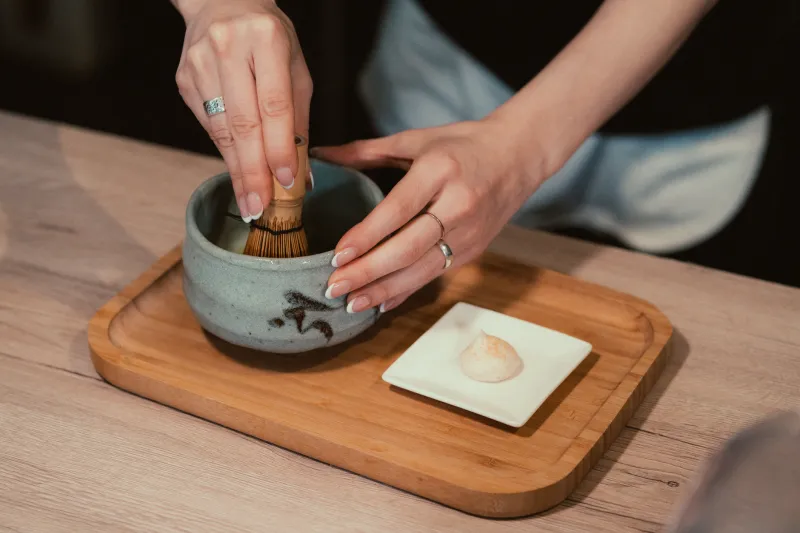
In traditional Japanese tea ceremony — chado, or the Way of Tea — a student might spend years learning a single movement. Not a sequence. Not a ceremony. A movement. The precise arc of a wrist while folding a fukusa cloth. The exact angle at which a chakin is wrung out. The specific sound a ladle should make when it rests against the side of a kama.
To a Western observer, this looks borderline insane. Why would anyone spend that long on something so small? But the tea master's answer reframes everything: because the point was never the movement. The movement is a vehicle for presence, for discipline, for the kind of focused attention that eventually transforms into something that looks effortless from the outside but is built entirely on invisible infrastructure.
Chado practitioners often describe the moment — sometimes years in — when the form stops feeling like a constraint and starts feeling like freedom. That's ri. And you cannot manufacture it on a timeline. You can only show up for shu long enough to earn it.
The Martial Arts Version of This Is Just as Brutal
If tea ceremony feels too serene to take seriously as a model, consider the martial arts tradition where shu-ha-ri originated. In aikido, judo, and kendo, beginners are not encouraged to "find their own style." They are taught to replicate the form of their sensei with near-mechanical precision. Creativity is actively discouraged in the early years.
This isn't about suppressing individuality. It's about understanding that genuine individual expression in a martial art requires a foundation so solid that the practitioner has options — real options, not just the illusion of options. A beginner who "expresses themselves" in a sparring match is usually just flailing with extra confidence. A master who expresses themselves has ten thousand hours of structured repetition underneath every spontaneous choice.
The American parallel here isn't hard to find. Think about jazz. The musicians who defined the genre — Coltrane, Miles Davis, Monk — were all obsessive students of traditional harmonic structure before they dismantled it. You don't get to Kind of Blue without first knowing every rule you're bending.
Why Skill-Stacking Is Making Us Worse
Here's where things get a little uncomfortable for the modern creative hustle crowd.
The past decade has produced an entire industrial complex around the idea that more skills equal more value. Stack enough competencies, the thinking goes, and you become some kind of rare, uncategorizable talent that the market can't ignore. There's a kernel of truth buried in this — genuine interdisciplinary thinking is real and valuable. But the way most people pursue it has almost nothing to do with shu-ha-ri and almost everything to do with avoiding the boring, humbling, ego-bruising work of actually getting good at one thing.
Learning a new skill feels productive. It scratches the growth itch without requiring the sustained discomfort of pushing past the point where a skill stops being exciting and starts being work. Most people abandon a practice right around the time it stops being a novelty and right before it starts becoming genuinely interesting — which is also, not coincidentally, right around the time the real learning begins.
Shu-ha-ri asks you to stay in that uncomfortable middle place long enough for something to actually happen.
How to Actually Apply This (Without Moving to Kyoto)
You don't need a sensei or a tatami mat to start thinking differently about mastery. A few practical shifts can make a real difference.
Pick one thing and stay with it longer than feels comfortable. If you're a writer, commit to one form — essays, short fiction, whatever — for at least a year before branching out. If you're a visual artist, pick one medium and don't move on until the tools feel like extensions of your body.
Find the rules before you break them. This is where most creative people skip ahead. Before you develop your "unique voice" or "signature style," learn the conventional version of your craft well enough to teach it. Understand why the rules exist. Then, and only then, start questioning them.
Measure depth, not breadth. Instead of asking "what new skill can I add this month," ask "how much deeper can I go into what I already know?" The answer to that question almost always leads somewhere more interesting.
Embrace the boring parts. The tea master folding the same cloth for the thousandth time isn't bored in the way we mean it in English. There's a Japanese concept — shokunin kishitsu, the craftsman's spirit — that describes finding meaning and even joy in the repetitive perfection of a single task. That's not a personality type. It's a practice.
The Payoff Nobody Tells You About
Here's the thing about ri — the transcendence stage — that doesn't get talked about enough: it doesn't look like what you expect. It's not dramatic. It's not a lightning bolt moment. It's more like one day you realize that the thing you've been practicing for years has become part of how you think, not just something you do.
That's what tea masters are really after when they spend years on a single movement. Not perfection of the movement. Transformation of the self doing the movement.
In a culture that's constantly pitching you on the next thing to learn, the most radical act might be to go deeper into what you already have — and stay there until something real happens.