Egg Salad at 2 A.M.: How the Konbini Became America's Newest Obsession
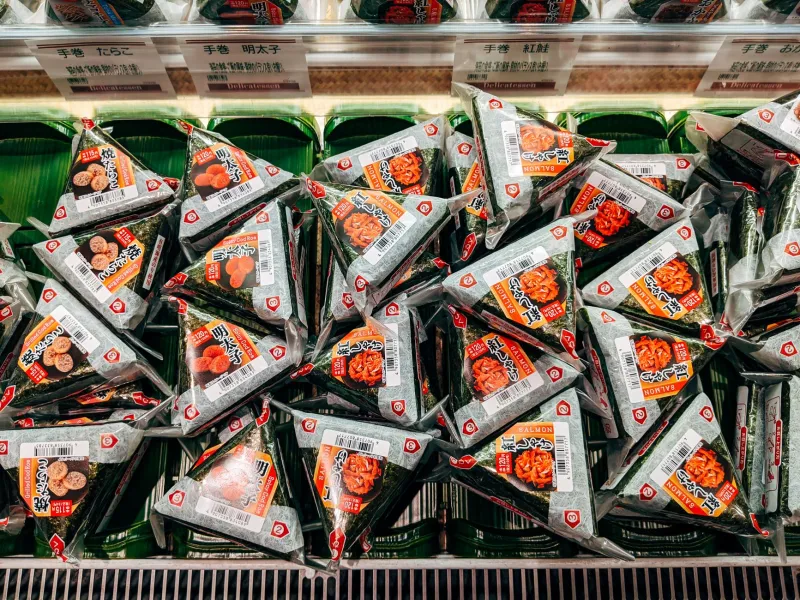
Scroll long enough on TikTok and you'll eventually land on it: a teenager in a Tokyo 7-Eleven at midnight, holding a triangle of nori-wrapped rice up to the camera like it's a Fabergé egg. The onigiri gets peeled with surgical precision — that satisfying pull where the plastic separates the seaweed from the rice — followed by the bite, the wide eyes, the reverent nod. Millions of views. Comments full of Americans typing "I NEED to go to Japan" in all caps.
If you've spent any time on the konbini side of the internet lately, you already know the hits: the onigiri peel, the egg salad sandwich (more on that later), the melon pan, the fluorescent-lit shelves of jelly drinks and bottled coffee. What started as travel vlog filler has become a full-blown genre, and honestly, it might be the most interesting food conversation happening on American social media right now.
The Sandwich That Launched a Thousand Flights
Let's talk about the egg sandwich, because no piece of konbini content is complete without it. Japanese convenience store egg salad — tamago sando — is famously, almost aggressively fluffy. The bread is a shokupan-style milk bread, pillowy and slightly sweet. The filling is less a chicken salad situation and more a cloud with a passport: whipped eggs, Kewpie mayo, a restraint that borders on poetic.
American egg salad, by comparison, tends to be a mayonnaise delivery vehicle with regret baked in. So when creators bite into a 300-yen sando and physically react — like they've been personally betrayed by every deli counter in the Tri-State area — it resonates. The video isn't really about a sandwich. It's about the gap between what we accept as normal and what's possible when someone cares.
What Is a Konbini, Actually?
For the uninitiated: a konbini is a Japanese convenience store — 7-Eleven, Lawson, FamilyMart — but the word "convenience store" undersells it badly. Yes, you can grab cigarettes and a Slurpee equivalent. You can also pay your utility bills, ship packages, buy concert tickets, and eat genuinely good, fresh food that turns over multiple times a day.
The food is the headline. Bento boxes, seasonal specials, fried chicken (Lawson's karaage-kun has its own fanbase), steamed buns in winter, and a rotating cast of limited-edition snacks that train customers to keep coming back. The quality control is legendary — Japan's convenience store industry treats a rice ball with the seriousness an American grocery chain reserves for, well, nothing.
This isn't an accident. Konbini food evolved to serve a country of busy commuters who stopped cooking elaborate meals decades ago. The stores had to become good, or people would've gone elsewhere. The result is a food culture built on the exact opposite premise of the American gas station, where "fresh" is a marketing term and the hot dog has a heat lamp tenure measured in geological epochs.
Why Americans Can't Look Away
There's a reason konbini content exploded specifically in the US. We're a country that invented the convenience store and then, somewhere along the way, stopped caring about it. Our 7-Elevens are descendants of the same company that runs Japan's — and the contrast is so stark it borders on comedy. Same logo, different universe.
Watching a konbini haul video, there's a flicker of recognition and then a wave of betrayal. We had this. We had the infrastructure, the brand, the real estate on every corner — and we got taquitos rolling on rollers. The videos work because they're not just food content; they're a mirror.
There's also something deeper in the appeal. American food culture is caught in a exhausting loop — either hyper-optimized wellness or shame-soaked indulgence, with very little room for food that's just... good, affordable, and available at 11 p.m. without a moral verdict attached. The konbini represents a third option. The onigiri is not a cheat day. The egg sandwich is not a guilty pleasure. It's just lunch, and it's excellent, and nobody's posting a disclaimer about it.
The Pilgrimage Problem
Of course, the trend has its friction points. The comments on any konbini video are now a predictable civil war: people who've been to Japan insisting the magic is real, people calling everyone gullible for romanticizing a gas station, and the occasional Japanese commenter gently pointing out that locals see konbini as a mundane part of the workday, not a spiritual destination.
They're all kind of right. The konbini is ordinary in Japan — that's the whole point. The magic American creators are discovering isn't some hidden gem; it's the result of a society that decided even its most disposable food should meet a baseline of care. Turning that into a bucket-list pilgrimage slightly misses the lesson. The interesting question isn't "how do I get to a Lawson?" It's "why did we decide convenience and quality have to be enemies?"
Some of that answer involves labor costs, supply chains, and agricultural policy — the unsexy scaffolding under every viral bite. But some of it involves expectations. Japanese customers expect konbini food to be good, so it is. American customers expect gas station food to be a punishment, so it is. Culture is a self-fulfilling prophecy with a checkout counter.
What to Take From the Trend
You don't need a flight to Haneda to participate in this conversation. The real takeaway is portable: care can show up in small, mass-produced, everyday formats. A snack doesn't need to be artisanal to be made with intention. A meal doesn't need a tasting menu to deserve good ingredients.
And if you do find yourself in Japan someday, do the konbini run — the egg sandwich, the onigiri, the hot case roulette. Just know that the thing you're actually tasting isn't the Kewpie mayo, however good it is. It's the flavor of a culture that never accepted the idea that quick should mean careless. That's a recipe worth importing, and unlike the sandwich, it travels perfectly.